What Is the Best Safari Route for Seeing Wildlife in Serengeti?
When people ask us at Havillah Tours & Safaris Ltd which route offers the best wildlife viewing in the Serengeti, our answer always starts the same way: it depends on when you’re traveling, what you want to see, and how deep into the ecosystem you’re willing to go. After years of running safaris through this vast landscape, our guides have learned that the Serengeti isn’t a single destination — it’s four distinct regions, each with its own rhythm, its own resident animals, and its own best season. Understanding these regions is the real key to planning a trip that delivers the sightings you’re dreaming of.
Understanding the Serengeti as a System, Not a Single Park
The Serengeti ecosystem spans nearly 30,000 square kilometers, stretching from northern Tanzania into Kenya’s Maasai Mara. Most first-time visitors assume they can simply “go to the Serengeti” and see the Great Migration on demand. In reality, over two million wildebeest, zebra, and gazelle move in a predictable but season-dependent loop across this land, and your route needs to intersect with where they actually are.
Our team tracks migration patterns year-round, cross-referencing ranger reports, radio-collar data shared by conservation researchers, and our own drivers’ daily sightings logs. This isn’t guesswork — it’s a discipline we’ve built over more than a decade of operating in the region, and it’s why clients trust us to place them in the right spot at the right time rather than simply driving to the most famous viewpoint and hoping for the best.
The Southern Serengeti and Ndutu Plains: Calving Season (December–March)
If your main goal is witnessing new life and the predator action that follows it, the southern Serengeti and the neighboring Ndutu area (technically part of the Ngorongoro Conservation Area) are unmatched between December and March. This is calving season, when up to 8,000 wildebeest calves can be born in a single day across these short-grass plains.
The open, flat terrain here makes for extraordinary visibility — you can often spot lion prides, cheetahs, and hyena clans stalking the herds from kilometers away. Cheetahs in particular favor this region because the flat ground suits their hunting style, and we routinely see cheetah mothers teaching cubs to hunt newborn calves here. Lodges and mobile camps in Ndutu tend to be smaller and more intimate than those in the central Serengeti, which appeals to travelers who want a quieter bush experience alongside the drama of calving season.
Best for: predator-prey action, newborn wildebeest and zebra, cheetah sightings, smaller crowds.
The Central Serengeti (Seronera Valley): Year-Round Reliability
The Seronera Valley is the beating heart of the park and the single most reliable area for wildlife viewing at any time of year. It sits at the crossroads of the migration routes and benefits from the Seronera River, which keeps resident wildlife in the area even during dry months when herds elsewhere have moved on.
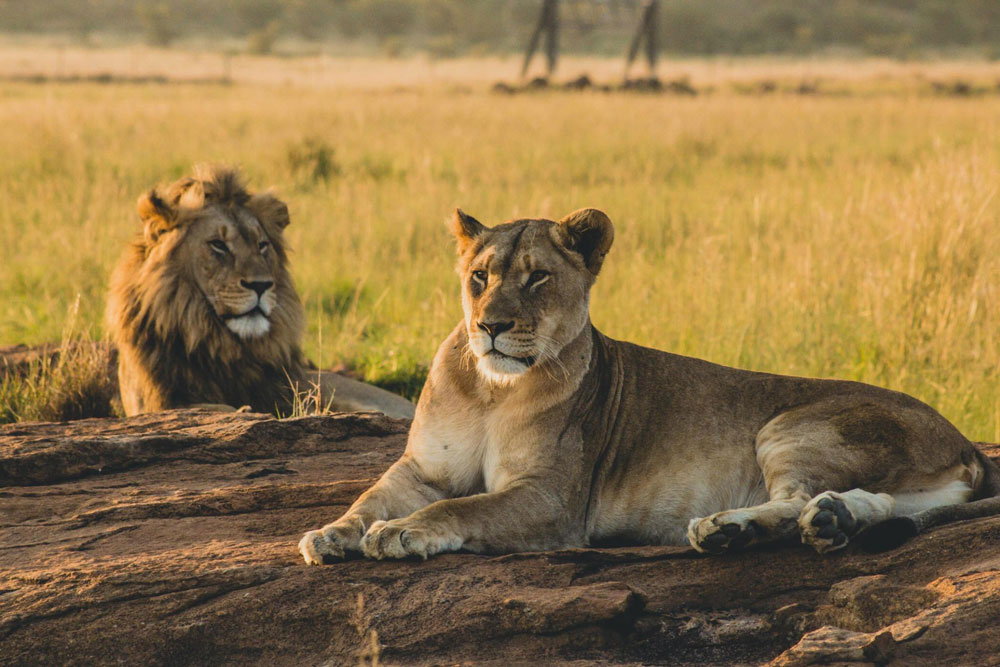
This is where we most often recommend first-time safari-goers spend at least two to three nights, because Seronera offers consistent sightings of lion, leopard, elephant, buffalo, and giraffe regardless of season. The valley’s rocky outcrops, known as kopjes, are a favorite resting spot for lion prides and offer some of the most photogenic backdrops in the entire park. Leopards, which are notoriously difficult to spot elsewhere, are seen here more frequently than almost anywhere else in East Africa thanks to the riverine forest along the valley floor.
Because of its central location and year-round game, Seronera is also the most heavily visited part of the Serengeti, so if solitude is a priority, we often pair a Seronera stay with time in a quieter region before or after.
Best for: big cats, year-round game viewing, first-time visitors, photographers wanting reliable leopard and lion encounters.
The Western Corridor: The Grumeti River Crossings (May–July)
As the dry season sets in and the herds begin pushing northward and westward in search of fresh grazing, the Western Corridor comes alive. This is where the wildebeest and zebra encounter the Grumeti River, home to some of the largest Nile crocodiles in Africa. Crossings here tend to be smaller and less chaotic than the famous Mara River crossings further north, but they can be just as dramatic, and the crowds are considerably thinner.
The Western Corridor is also notable for its black-maned lions and its resident population of colobus monkeys in the forested riverbanks, a habitat type you won’t find elsewhere in the park. Because this region sees fewer vehicles than the central or northern Serengeti, our guides often describe it as a hidden gem for travelers who’ve already done a classic migration safari and want something quieter but still rich in wildlife.
Best for: river crossings without the Mara River crowds, unique riverine habitat, crocodile sightings, travelers seeking fewer vehicles.
Northern Serengeti and the Mara River: The Dramatic Crossings (July–October)
For many travelers, the image that defines an African safari — wildebeest leaping into a crocodile-infested river, clambering up muddy banks, chaos and adrenaline in every frame — happens in the Northern Serengeti along the Mara River. From roughly July through October, the migration funnels through this region as the herds cross back and forth between Tanzania and Kenya in search of rain-fed grass.
This is unquestionably the most dramatic wildlife spectacle in the Serengeti ecosystem, but it comes with trade-offs. The north is harder to access, generally requiring either a longer drive or a scheduled light-aircraft flight, and lodges here tend to be pricier and more exclusive. Crossings are also unpredictable by nature — herds can gather at a crossing point for days before committing, so patience (and a guide who understands herd behavior) matters enormously.
We always tell clients booking a northern itinerary that the reward is worth the logistics, but it’s not a trip to improvise. Having experienced local guides who communicate with other camps and rangers via radio to track herd movement in real time can mean the difference between witnessing a crossing and missing it by a day.
Best for: the classic river-crossing spectacle, serious wildlife photographers, travelers wanting the single most dramatic migration moment.
So, Which Route Is Actually “Best”?
Having walked through all four regions, here’s our honest, experience-based answer: there is no single best route — there is a best route for your travel dates and priorities.
- Traveling December to March? Head south to Ndutu and the southern plains for calving season.
- Traveling year-round or unsure of timing? Base yourself in Seronera for consistent, reliable sightings of all the major species.
- Traveling May to July? The Western Corridor offers river crossings with far fewer crowds.
- Traveling July to October and want the iconic Mara River crossing? Commit to the Northern Serengeti, ideally with at least three nights to allow for unpredictable crossing timing.
Many of our most satisfied clients actually combine two regions in a single trip — for example, starting in Seronera for guaranteed big-cat sightings, then moving north or south depending on the season to catch the migration at its most active phase. This kind of multi-camp itinerary requires careful route planning and realistic drive-time expectations, which is exactly where a knowledgeable ground operator earns its keep.
Why Local Expertise Changes the Outcome
A map alone won’t get you to the right sighting. The migration shifts based on rainfall patterns that can vary from year to year, sometimes by weeks. We’ve seen seasons where herds lingered in the south longer than usual because of late rains, and others where the Mara crossings began earlier than the “typical” July start date because the northern plains dried out faster than normal.
This is why our guides stay in daily contact with other operators, park rangers, and pilots flying over the plains — building a live picture of herd locations that no guidebook or blog post can offer. When you book a Serengeti Safari with a team that has boots on the ground every single day of the year, you’re not relying on averages; you’re relying on current, verified intelligence about where the animals actually are right now.
Planning Your Tanzania Safari with Havillah Tours & Safaris Ltd
At Havillah Tours & Safaris Ltd, we design each itinerary around the specific months our clients are traveling, matching routes to the realistic migration window rather than a generic “see everything” promise that no single route can fulfill. Our vehicles, drivers, and camp partnerships span all four regions of the ecosystem, which means we can build a custom multi-region route rather than locking you into whichever camp happens to have availability.
We also believe transparency matters as much as expertise. If the migration has shifted later than expected in a given year, we tell clients honestly rather than overselling a sighting we can’t guarantee. Wildlife viewing is never 100% predictable, but informed route planning dramatically improves your odds, and that’s the service we specialize in.
Whether you’re drawn to the predator drama of the southern plains, the reliable big-cat sightings of Seronera, the quieter river crossings of the Western Corridor, or the bucket-list spectacle of the Mara River, we can help you choose — and book — the right combination among Tanzania’s many Tanzania Safari Destinations. Reach out to our team, tell us your travel dates and priorities, and we’ll map out the route that gives you the best realistic chance of seeing the Serengeti at its most alive, as part of a wider set of Tanzania Safari Tours we offer across the region’s national parks and conservation areas.